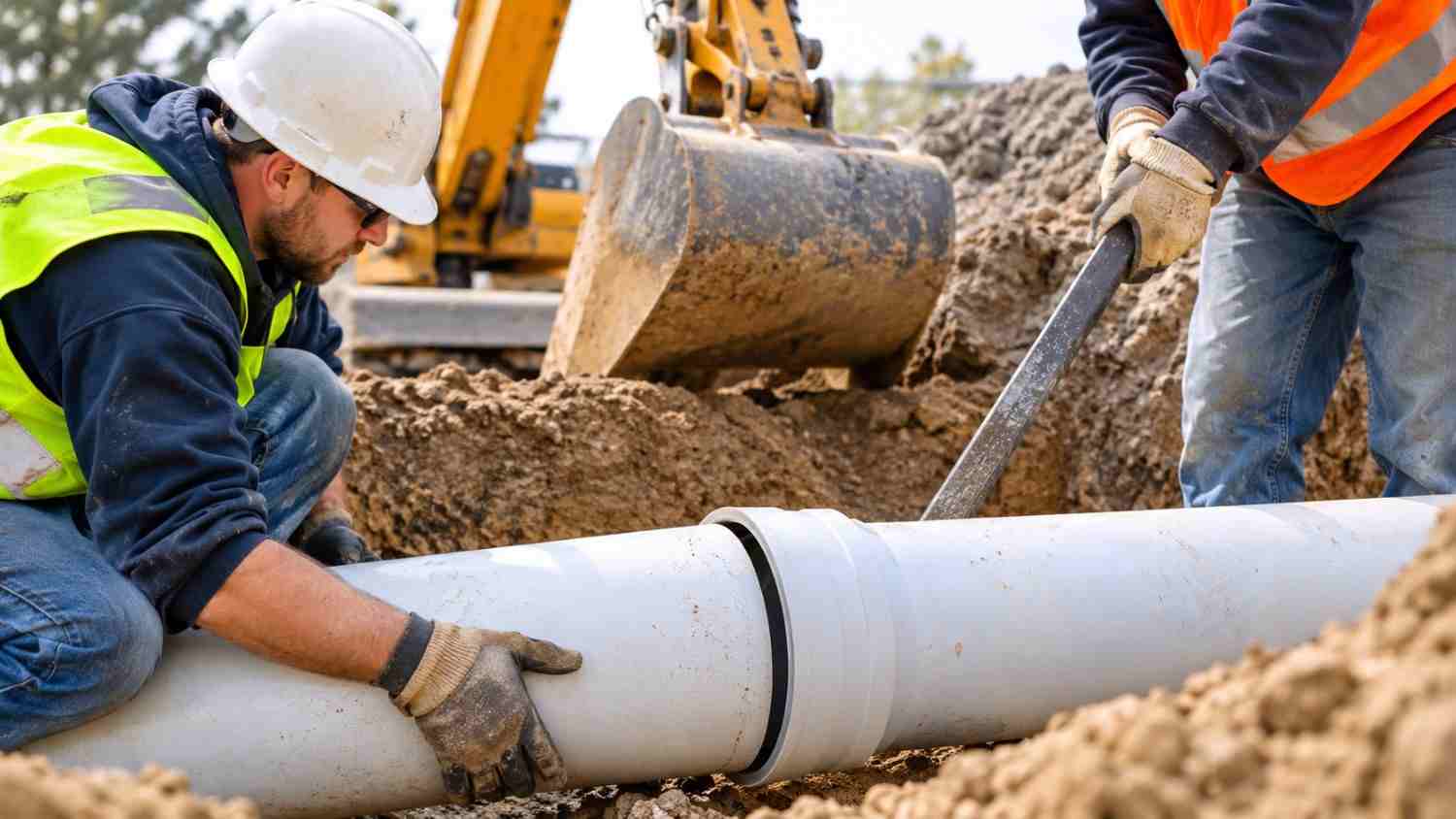
A 10-inch PVC pipe sits in the trench, the crew wants to finish, and someone waves the backhoe over to nudge the joint home. Pushing large PVC pipe with an excavator bucket or a steel pry bar causes over-belling, rolled rubber gaskets, cracked bell sockets, and leaking solvent-cement welds. A backhoe operator cannot feel the socket stop from the cab, and a pry bar levers the pipe upward at an angle instead of driving it straight.
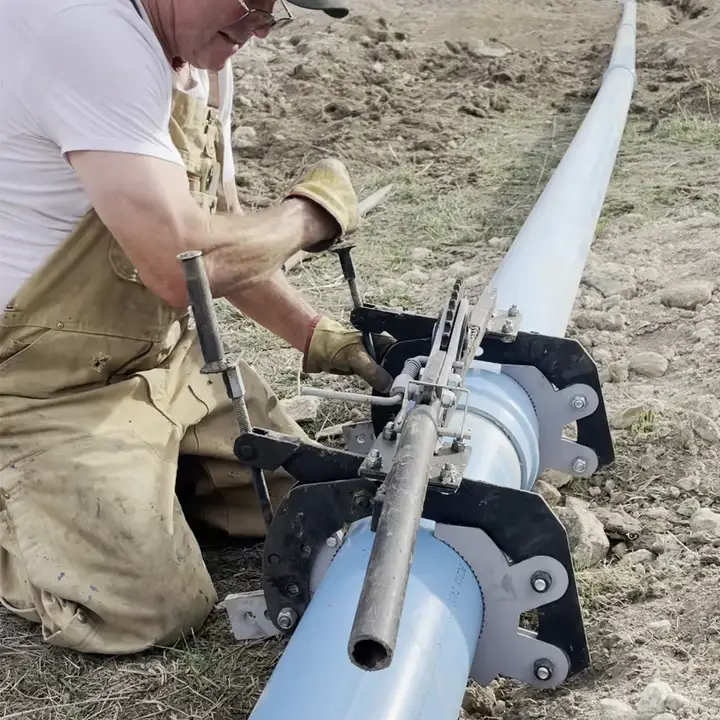
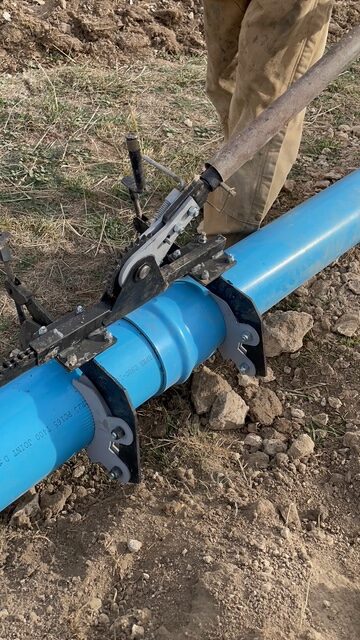
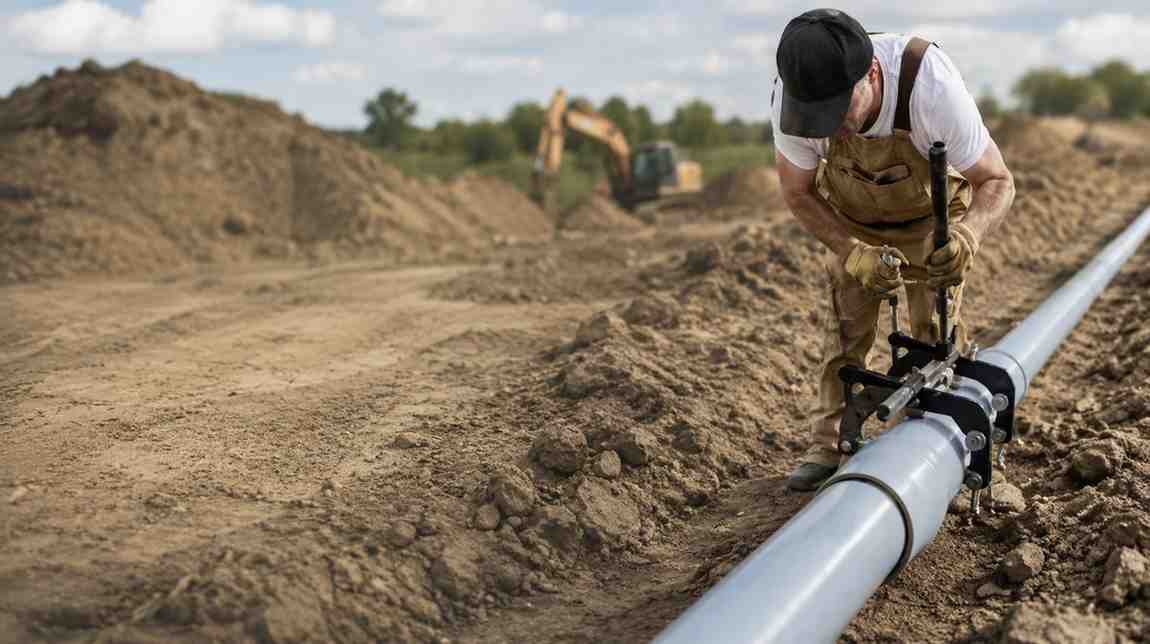
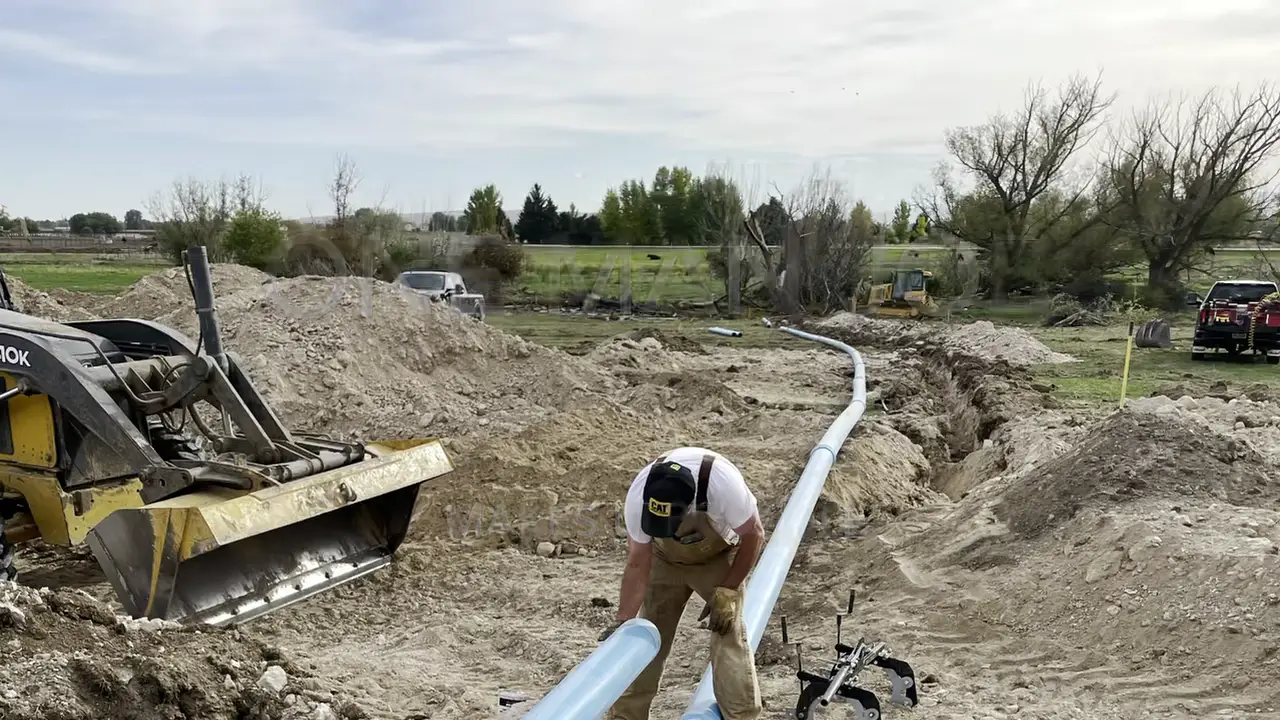
To seat 3-inch to 12-inch PVC pipe safely, use our over-the-pipe pipe fitting alignment tools that lock around both pipe ends and pull them together along one straight centerline. At The PipeFitter, we have built our hardened steel clamp-and-drive system in Swan Valley, Idaho, since 2004, so one worker can apply up to one ton of steady force without heavy machinery.
Why Do Crews Reach for a Backhoe or Pry Bar on Large PVC Pipe?
Crews reach for a backhoe bucket or a pry bar because 6-inch to 12-inch PVC pipe creates too much socket taper friction and rubber gasket resistance for one or two workers to push by hand. Once pipe diameter passes 4 inches, manual push force runs out before the spigot hits the socket stop.
When your crew is down in the trench asking why an 8-inch or 12-inch pipe refuses to slide the last two inches into the bell, two physical forces are fighting them:
- Tapered socket friction on glued joints: Standard PVC fittings have an inward-tapered socket wall that grips the pipe tighter across the final third of travel, while fast-setting solvent cement grabs within 60 to 120 seconds.
- Rubber ring compression on gasketed pipe: Heavy-wall AWWA C900 and SDR pressure pipes use a tight elastomeric gasket inside the bell groove that takes hundreds of pounds of straight thrust to compress.
The Weld-On Solvent Welding Guide states that joining 6-inch and larger pipe requires a multi-person crew and a mechanical pipe puller to seat the spigot before the cement sets. Without a puller on the truck, crews improvise with nearby equipment.
What Happens to a PVC Joint When You Push It With a Backhoe Bucket?
Pushing a PVC pipe joint with a backhoe bucket removes all feel and control, driving the spigot past the factory depth mark and cracking the bell or rolling the sealing gasket. Hydraulic buckets push with thousands of pounds of unmeasured force, while a PVC joint needs straight-line travel that stops on a painted mark.
Pipe joiners often wonder why a joint fails its hydrostatic pressure test when the spigot went all the way to the mark, or whether a 2×4 wood block against the bucket makes backhoe pushing safe. Even with a spotter and a wood block, backhoe pushing causes four costly failures:
1. Over-Belling the Socket End
Gasketed PVC pipe uses a painted insertion mark, and glued fittings have a molded socket stop. As the IPEX PVC Pressure Piping Systems Installation Guide warns, an operator in a cab cannot see the insertion mark clearly, and over-inserting a joint damages both the active bell and the assembled joints behind it. Driving a tapered spigot past the stop wedges the bell outward and splits the socket wall.
2. Rolling or Pinching the Rubber Gasket
Gasketed bell-and-spigot pipe requires a 10-degree to 22-degree bevel and straight entry so the spigot slides cleanly under the rubber lip. A backhoe bucket moves in a downward arc while pushing forward, driving the spigot nose into the rubber ring and rolling the gasket out of its groove.
3. Breaking Upstream Joints in the Pipeline
Shoving a 20-foot pipe length with an excavator sends a shockwave down the pipeline. On solvent-welded runs, that jolt breaks the fresh bond on the last two or three fittings your crew just glued.
4. Scraping Wet Cement and Gouging Pipe Ends
In solvent welding, an angled shove scrapes wet cement off one side of the pipe wall and leaves a dry gap opposite it. Even with a wood block against the bucket, a shifting bucket tooth chips the pipe bevel.
Does a Pry Bar and Wood Block Protect 6-Inch to 12-Inch PVC Pipe?
A pry bar and wood block can seat small gasketed pipe in soft bedding, but on 6-inch to 12-inch PVC it levers the pipe upward, binds the socket, and lets glued joints slide back out. A steel bar anchored in trench dirt pushes at an upward arc instead of straight down the centerline.
The Westlake Pipe & Fittings Pressure Pipe Installation Guide states that crews must place a wood block between any pry bar and the pipe end to stop point-load gouging. Yet installers still ask why an 8-inch glued pipe creeps back out of the socket the second they let go of the bar. Even with a wood block, pry bars fail on large pipe for three reasons:
- Upward levering cocks the spigot: Digging a bar into the trench floor lifts the pipe end as you pull back, binding the spigot inside the bell and exceeding JM Eagle C900 Installation Guide deflection limits during entry.
- Jerky strokes ruin solvent welds: Solvent cement requires one smooth push to the socket bottom. Pumping a bar in short strokes gives fast-setting cement time to grab halfway in.
- Zero hold against socket push-back: Once you release bar pressure on an 8-inch or 12-inch glued joint, the tapered socket squeezes the wet pipe backward out of the fitting.
Using dedicated PVC pipe tools removes that upward prying angle and locks the joint until the cement sets.
How Do Backhoes, Pry Bars, and Mechanical Pipe Alignment Tools Compare?
Mechanical pipe alignment tools beat backhoes, pry bars, and ratchet straps by combining straight centerline alignment, up to 2,000 pounds of controlled pull force, and hands-free holding power in a one-person frame.
| Factor | Backhoe Bucket | Pry Bar & Block | Ratchet Straps | The PipeFitter Tool |
| Force Angle | Downward arc | Upward lever | Uneven side pull | Straight centerline |
| Depth Control | Blind; over-bells | Jerky; stops short | Stretches and slips | Stops on the mark |
| Bell Safety | Cracks bells | Gouges pipe end | Pinches gaskets | Holds pipe square |
| Glued Hold | Creeps forward | Zero hold | Loses tension | Locks through set |
| Crew Size | 3 workers | 2 to 4 workers | 2 workers | 1 operator solo |
| Stuck Joints | Breaks pipe | Cracks socket | Pulls one way | Reverses to pull out |
What Should You Use Instead to Align and Seat 3-Inch to 12-Inch PVC Pipe?
Use an over-the-pipe mechanical clamp-and-drive tool that grips the outside diameter of both pipe ends, aligns them on a rigid steel yoke, and pulls the spigot into the bell with a ratchet or lever drive.
When contractors compare industrial pipe alignment tools, they often ask how one tool handles everything from sun-bowed pipe and heavy tees to muddy trench floors. At The PipeFitter, we build our PVC pipe fitting tools as one core clamp-and-drive unit with interchangeable parts that replace brute force:
1. Interchangeable Stationary and Traveling Clamp Shoes
Instead of buying a separate machine for every pipe size, you swap curved steel clamp shoes onto the frame to match your pipe from 3 inches to 12 inches. The stationary clamp holds the bell, elbow, tee, or reducer steady while the traveling clamp grips the spigot barrel, guiding slightly out-of-round pipe cleanly into the socket.
2. Rigid Steel Universal Clamp Yoke
A hardened steel yoke bridges the two clamps above the pipe so the spigot cannot dip, lift, or enter at an angle. You keep a clear view around the socket face to check your insertion mark and cement bead.
3. Ratchet or Bi-Directional Lever Drive (Up to 1 Ton of Force)
Working the ratchet or lever pulls the traveling clamp straight toward the stationary clamp with up to 2,000 pounds of smooth force. On solvent-welded Schedule 40 and 80 pipe, the drive stays locked to stop push-back during initial set. If a fitting stalls while the cement is wet, our bi-directional lever drive reverses to back the pipe out cleanly.
4. Optional Support Legs for Trench and Shop Work
Optional support legs raise the pipe off muddy trench floors so one installer can clean, prime, apply cement or gasket lube, and seat the joint without dirt entering the socket.
How Do You Configure The PipeFitter Tool for Different Pipe Sizes and Schedules?
Configure The PipeFitter tool by selecting the yoke capacity, drive assembly, and interchangeable clamp shoe sets that match your pipe’s actual outside diameter (OD), wall schedule, and joint type.
Contractors frequently ask whether they need a whole new puller for every pipe size on a job. Because our system is modular, you use the same core tool and simply swap clamp shoes and yoke assemblies across our professional pipe alignment solutions:
- Light-Duty (LD) 3-Inch to 4-Inch Setup: Uses our LD/MD ratchet drive assembly with quick 3-inch and 4-inch twist clamps for commercial plumbing and tight mechanical rooms.
- Medium-Duty (MD) 3-Inch to 8-Inch Setup: Pairs a 13-inch universal clamp yoke and ratchet or bi-directional lever drive with interchangeable MD clamp shoe sets for 3″, 4″, 6″, and 8″ pipe.
- Heavy-Duty (HD) 6-Inch to 12-Inch Setup: Combines a 14-inch or 16-inch universal clamp yoke and bi-directional lever drive with interchangeable HD clamp shoe sets for 8″, 10″, and 12″ mains.
- IPS vs. CIOD Clamp Shoe Check: Always verify actual outside diameter before choosing clamp shoes. An 8-inch Schedule 40 or 80 pipe measures 8.625 inches OD (Iron Pipe Size), while an 8-inch AWWA C900 pipe measures 9.05 inches OD (Cast-Iron Outside Diameter).
To equip your crew with field-proven PVC pipe tools, browse our catalog or call our team at +1-805-237-9993. We will match the right industrial pipe alignment tools,professional pipe alignment solutions,PVC pipe fittings tools, and pipe fitting alignment tools to your job specs.
Frequently Asked Questions
Can I push PVC pipe with a backhoe if I use a wood block?
No. A wood block only stops bucket teeth from scratching the pipe; it does not prevent downward angles, rolled gaskets, or over-belling past the stop mark.
Why does 8-inch PVC pipe slide back out after I push it with a pry bar?
PVC sockets taper inward for an interference fit. Until the cement sets, that taper squeezes the wet spigot backward because a pry bar cannot lock the joint.
Do I need a separate alignment tool for each PVC pipe diameter?
No. The PipeFitter uses one modular yoke-and-drive frame; you simply swap interchangeable clamp shoe sets sized for your specific 3-inch to 12-inch pipe outside diameter.
Do Schedule 80 PVC and AWWA C900 pipe use the same clamp shoes?
No. Schedule 40 and 80 use Iron Pipe Size (IPS) outside diameters, while AWWA C900 uses larger Cast-Iron Outside Diameter (CIOD) dimensions, requiring matching clamp shoes.
Can an alignment tool pull apart a PVC fitting if it jams halfway in?
Yes, while the cement is wet or on gasketed pipe. Our bi-directional lever drive reverses force to pull the spigot straight out without cracking the bell.
How many workers do you need to join 12-inch PVC with an alignment tool?
One worker can align, pull, and hold a 10-inch or 12-inch joint once the pipe sits in the trench, replacing a 3- to 4-person manual push crew.