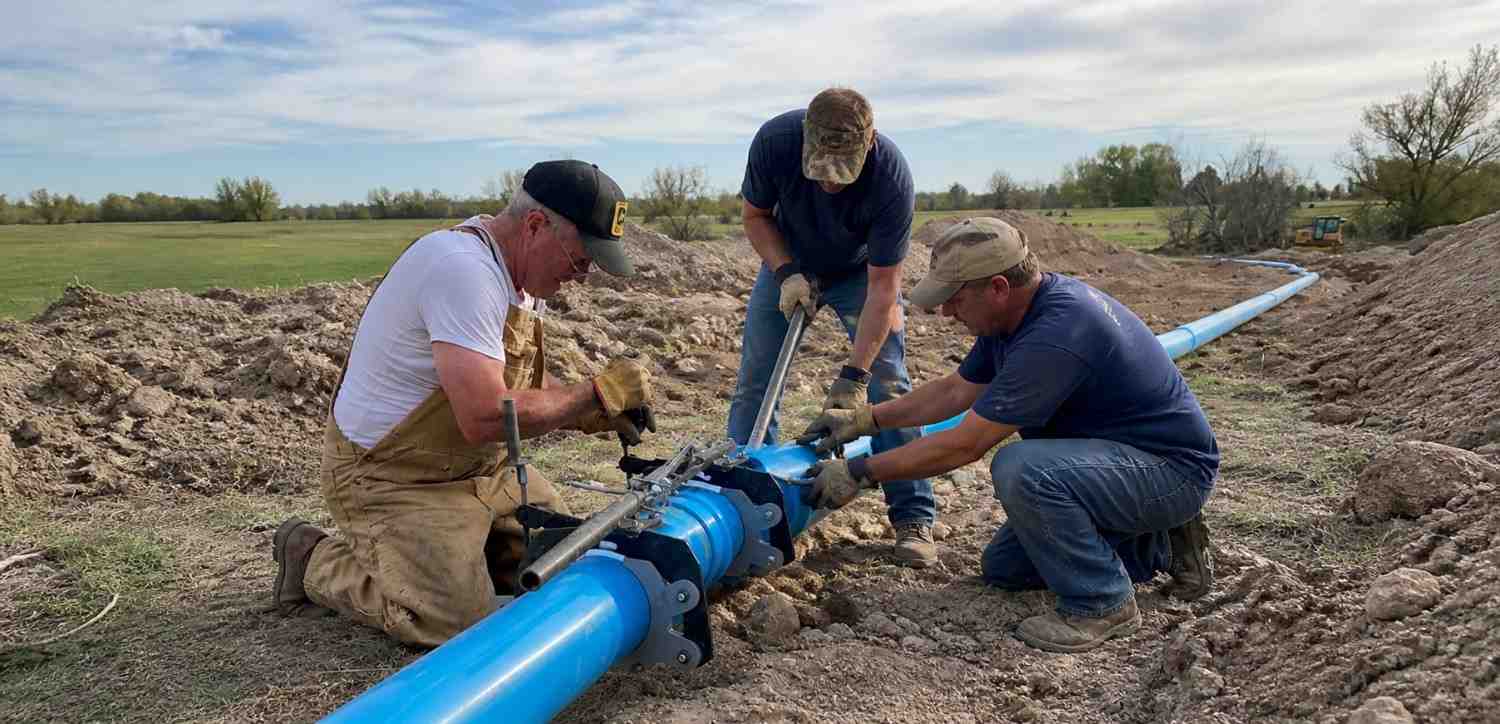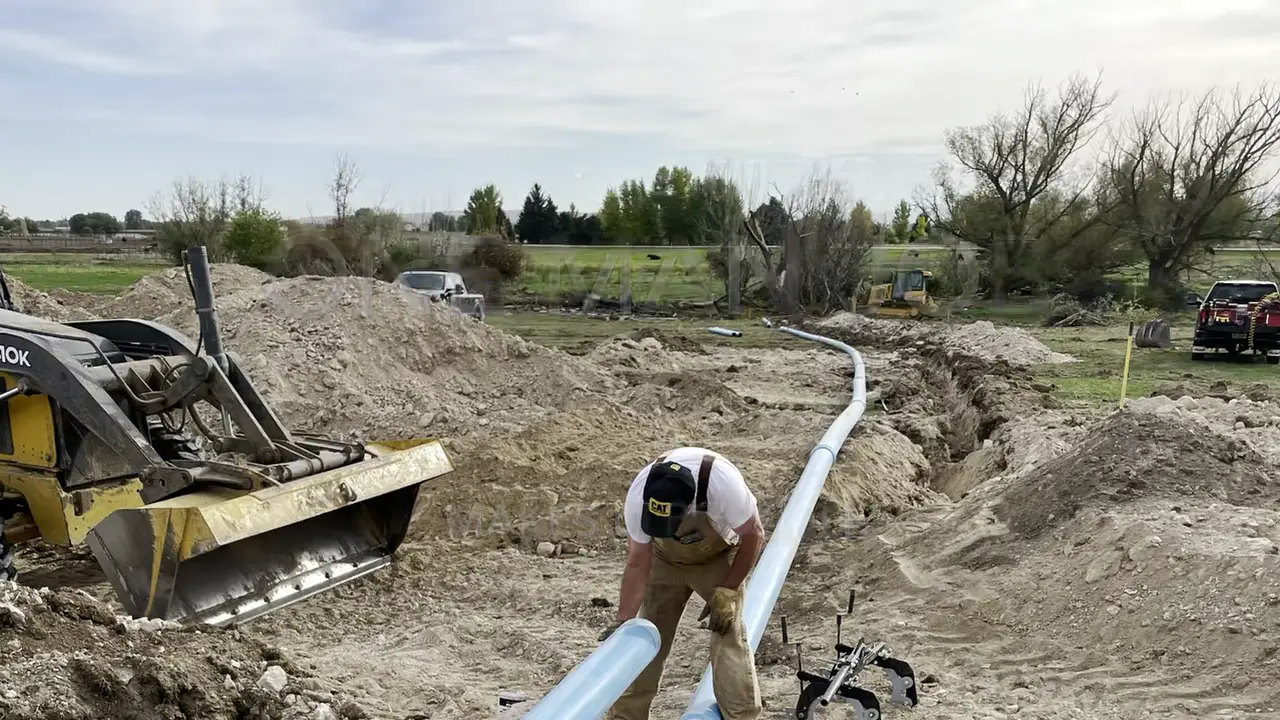
Large-diameter PVC joints fail for a small set of predictable reasons: under-insertion, over-belling, out-of-round bells, and the wrong seating force applied the wrong way. None of these is a material defect. There are installation conditions that the right tool prevents. This guide covers each failure mode, the standards that govern the work, and what a serious pipe alignment tool manufacturer builds into the tool to fix it. Written by The PipeFitter, manufacturing PVC alignment clamps from Swan Valley, Idaho, since 2004.
What counts as a “large-diameter” PVC joint?
For this discussion, large-diameter means 3″ through 12″ for solvent-cement work governed by ASTM D2855, and 4″ through 60″ for gasketed pressure pipe governed by AWWA C900 and C905. These joints behave differently from residential 1/2″ to 2″ plumbing in three ways: the seating force required scales steeply with diameter, the working time on solvent cement is shorter relative to the assembly window, and the bell is more prone to ovality from handling and storage.
Typical applications where this work shows up:
- Municipal water distribution mains (AWWA C900 territory)
- Irrigation header lines on commercial and agricultural sites
- Industrial process piping and drain mains
- Large HVAC condensate and stormwater stacks
- Sewer force mains
What is under-insertion, and how deep should PVC pipe actually go?
Under-insertion is when the spigot fails to reach the manufacturer’s marked insertion line inside the bell. The joint looks finished on the surface, but the bonded surface area is incomplete. The seal fails later, usually under service pressure, and the failure is rarely traced back to the installation.
How to read the insertion mark correctly
C900 pipe spigots ship with two factory-marked insertion lines because bell socket depths vary between manufacturers. AWWA C605 requires the installer to match the bell manufacturer’s specified depth, not a generic rule of thumb. A few points worth knowing:
- The shallower insertion line corresponds to a maximum-deflection joint
- The deeper line corresponds to a straight, fully-seated joint
- On 10″ and 12″ pipe, eyeballing the line is not reliable
- Peer-reviewed research on PVC push-fit joints confirms that insertion depth has the largest single influence on joint stiffness.
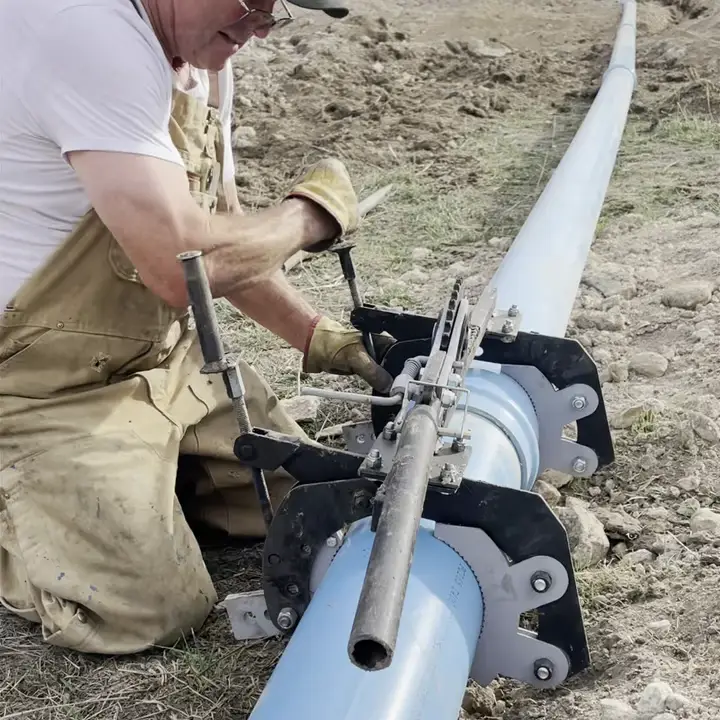
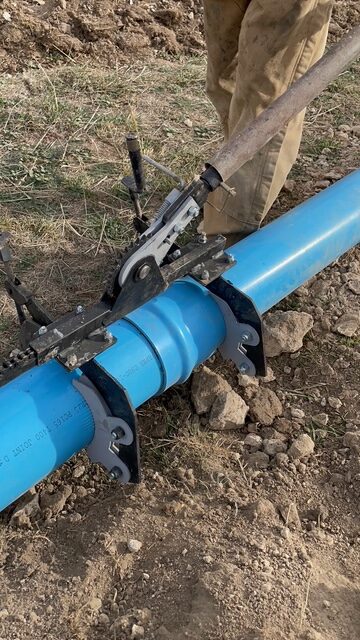
This is the failure mode that proper PVC pipe installation tools eliminate. A clamp-based mechanism gives the operator a positive mechanical stop at the insertion line, which manual seating cannot offer at large diameters.
What is over-belling, and why does it split the bell?
Over-belling is the opposite problem. The spigot is forced past the insertion line and contacts the shoulder of the bell. The continued force splits the bell along its length. Sometimes the crack shows up immediately. Sometimes it appears weeks later under service pressure. Forensic field reports identify over-belling as the most common installation defect on AWWA C900 pipe.
Over-belling is almost always caused by improvised methods. A backhoe applying uncontrolled force, a hammer strike that drives the pipe too far, or a ratchet strap that cannot be stopped at the right depth.
Why does an out-of-round PVC bell cause failure, and how do you fix it?
PVC pipe stored on uneven ground, stacked too high, or left in direct sunlight deforms from circular to oval. An oval bell cannot seat a round spigot evenly, which leaves gaps along part of the circumference. Those gaps become the leak path.
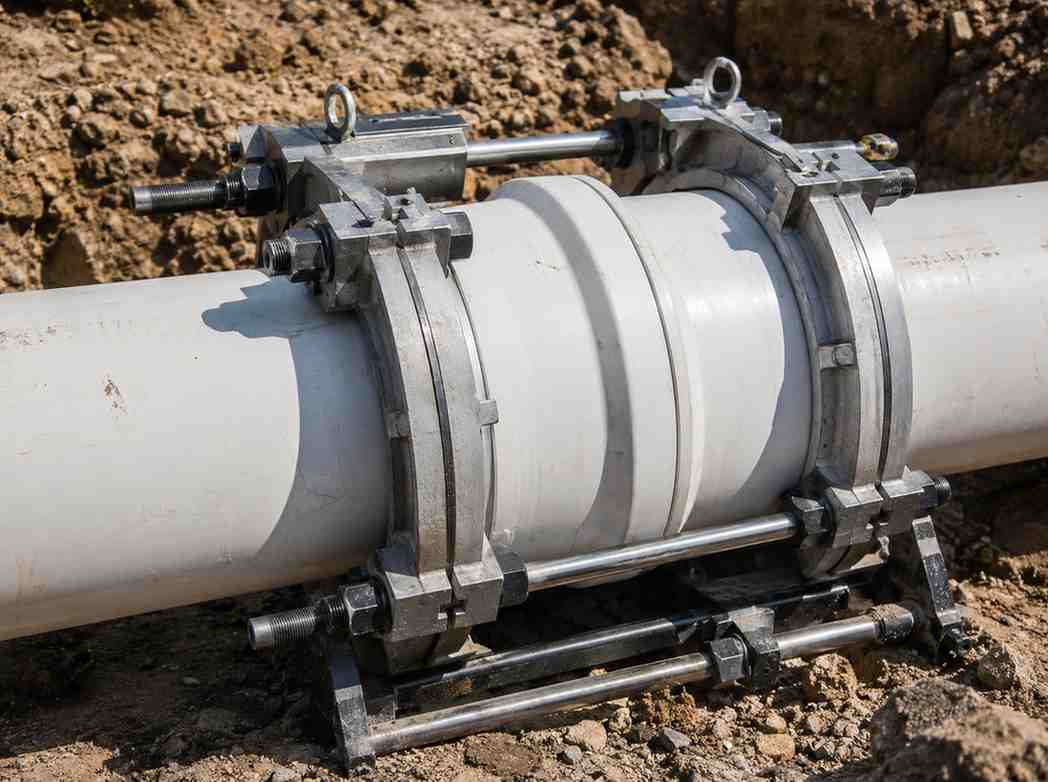
The fix is mechanical. Proper pipe fitting alignment tools apply even circumferential force, which reshapes the bell during seating and restores concentricity. Rigid fixtures and improvised straps cannot do this. The clamp mechanism The PipeFitter uses adapts to mild ovality without forcing the pipe out of round in the other direction.
How much force does it take to seat a large PVC pipe?
Industry installation guides from Westlake, JM Eagle, and Diamond Plastics state that pipe above 6″ requires mechanical assistance to apply sufficient seating force. Below 73.4°F (the reference temperature at which PVC properties are calibrated), the pipe stiffens, and the required force climbs further. Above that temperature, working time on the solvent cement shortens, which compresses the assembly window.
The practical breakdown:
| Pipe size | Manual joining feasibility | Recommended approach |
| 3″–4″ | One person, short pieces only | Hand seating with a light clamp |
| 6″–8″ | Two people, fresh cement | Mechanical clamp recommended |
| 10″–12″ | Not safely manual | Mechanical clamp required |
| C900 above 12″ | Never manual | Heavy-duty clamp with controlled press force |
Can one person join a 10″ or 12″ PVC pipe?
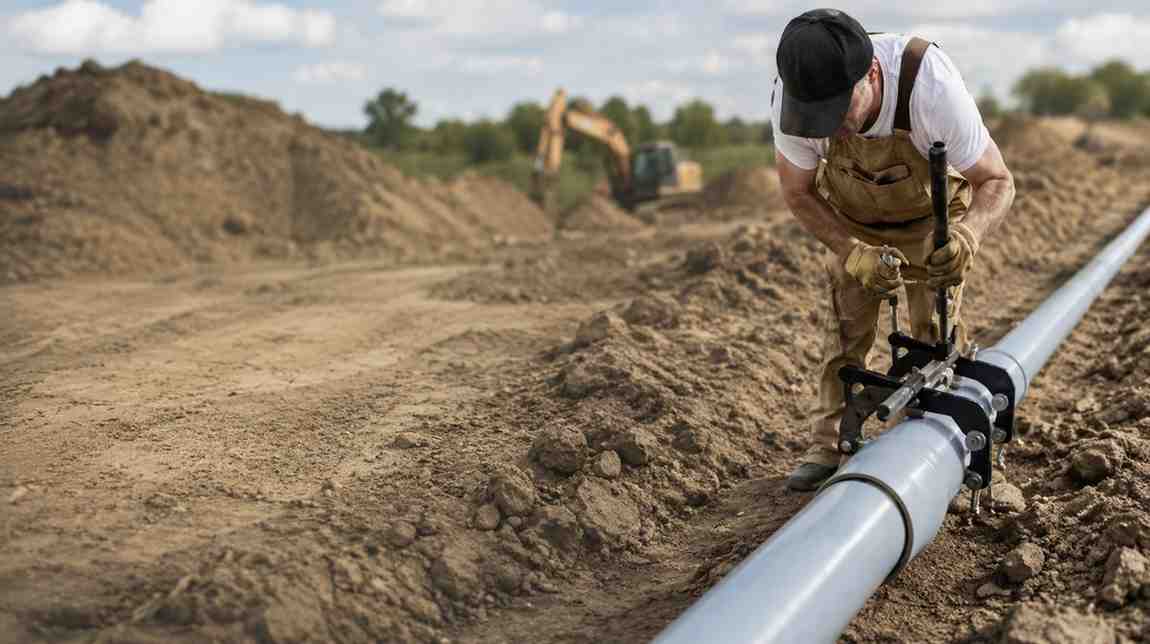
Yes, with an over-the-pipe clamping mechanism designed for single-operator use. The clamp holds the bell and spigot in alignment. A ratchet or lever drive applies up to one ton of controlled press force. The operator works alone, hands free from the seating motion.
One example from the field: an irrigation contractor previously needed three workers half a day to install a 10″ header line. With a heavy-duty clamp from the industrial pipe alignment tools category, the same install took one worker under three hours. The labor math compounds across a project. On 200 joints, even ten minutes saved per joint clears 33 labor hours.
Why are hammers, pry bars, and backhoes the wrong tools?
AWWA installation guidance explicitly warns against high-impact hammer-type equipment on PVC pressure pipe. The reasons are mechanical:
- Uncontrolled force causes over-belling and bell splits
- Point loads from hammer strikes crack the pipe wall before the joint seats
- Backhoe pressure routinely exceeds the bell’s lateral strength
- None of these methods gives the installer a clean stop at the insertion line
Alongside proper PVC pipe cutting tools that produce a square, deburred end, an alignment clamp is the second half of a clean install. The cut sets the geometry. The clamp sets the seal.
What does The PipeFitter build into the tool to prevent all of this?
Since 2004, The PipeFitter has manufactured one category of equipment: over-the-pipe clamps for PVC alignment. The product range covers the full set of PVC pipe fittings tools used on alignment work:
- HD 10″ Heavy Duty Clamp Set for industrial and municipal work
- MD 6″ Medium Duty Clamp Shoe Set for standard commercial sizes
- MD Pipefitter Ratchet Drive / 13″ Universal Clamp Yoke for high-force seating
- Speed Handles are sold as individual inventory parts for cycle-time gains
- Hardened steel construction across all load-bearing components
- One-ton controlled press force, no impact strikes
- Single-operator design across the 3″ to 12″ range
This is what separates a real pipe alignment tools manufacturer from a reseller: every wear component is sold as a separately orderable part. When a clamp shoe reaches the end of life, you replace the shoe, not the full kit.
How do you choose the right model for your jobs?
| Job type | Pipe range | Recommended setup |
| Residential and light commercial irrigation | 3″–6″ Schedule 40/80 | MD 6″ Medium Duty Clamp Shoe Set |
| Municipal water mains, large irrigation header | 6″–10″ C900 | HD 10″ Heavy Duty Clamp Set |
| Industrial process and drain mains | 10″–12″ | HD 10″ with Ratchet Drive |
| Crews running 50+ joints per week | Any range | Add Speed Handles for faster cycle |
Pairing the clamp with quality PVC pipe cutting tools (clean square cut, deburred end, beveled lead-in) is what makes the install repeatable. Together, they form the core kit of PVC pipe installation tools any large-diameter crew should carry.
Talk to the team before you buy
If you have a project on the calendar and want a recommendation on the right clamp for your pipe size, working conditions, and crew setup, the team at The PipeFitter walks you through it on a single call. Direct line to the people who built the tool.
Phone: +1-805-237-9993
Email: gbills48@gmail.com
Shop the full product range :the-pipefitter.com
Order the HD 10″ Heavy Duty Clamp Set or the MD 6″ Medium Duty Clamp Shoe Set directly from the shop, or call before you buy if you want sizing confirmed for your job.
FAQ
1. What is the minimum cure time before pressure testing a PVC joint?
Per ASTM D2564, the minimum hydrostatic burst strength of 400 psi is reached at 2 hours of cure. Most cement manufacturers recommend 24 hours before full system pressurization. Cure time extends in cold weather and shortens in heat, so always check the cement label for the ambient temperature on the day of install.
2. Does The PipeFitter sell replacement parts separately?
Yes. Clamp shoes, yokes, ratchet drives, and speed handles are all sold as individual inventory parts. You do not buy a full kit again when one wear component reaches the end of its life. The PVC pipe fittings tools we make are designed for component-level repair.
3. Will the tool work on out-of-round or deformed PVC pipe?
Yes. The clamp adapts to mild ovality and gap conditions that defeat rigid fixtures. It applies even circumferential force during seating, which helps re-round the bell. This is one of the conditions that pipe fitting alignment tools are specifically designed to handle.
4. Can the tool be used on both solvent-cement and gasketed joints?
Yes. The same clamp mechanism seats solvent-cement joints under ASTM D2855 and gasketed bell-and-spigot joints under AWWA C900 with ASTM F477 elastomeric gaskets. The seating motion is the same. Only the prep changes.
5. Where is The PipeFitter manufactured, and who do I call with a technical question?
Designed, built, and supported in Swan Valley, Idaho, since 2004. Industrial pipe alignment tools require manufacturer support when sizing for a specific job. The team takes those calls directly at +1-805-237-9993 and answers technical questions on the spot.