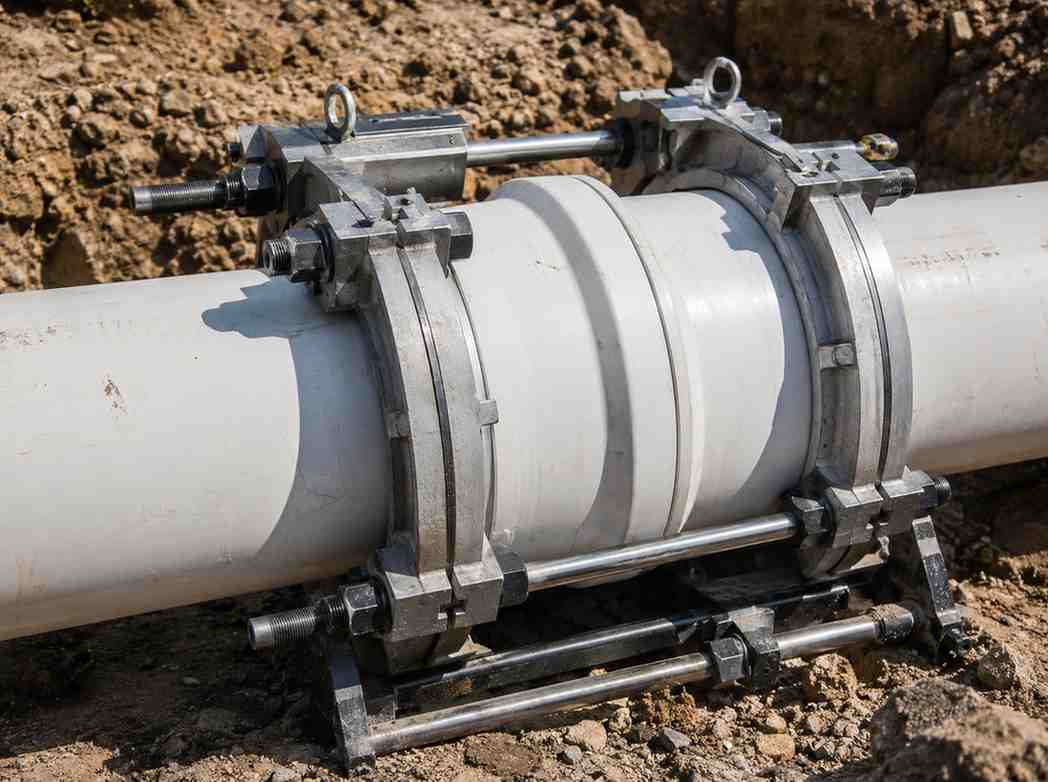
Most large-diameter PVC joint failures are not material defects. They are installation errors. At 6 inches and above, every risk in pipework multiplies. More force is required, the working window is shorter, and push-back from the fitting is stronger. Contractors on municipal mains, irrigation headers, and industrial drainage runs face these conditions on every job.
The right PVC pipe installation tools exist because manual methods were never built to handle these conditions consistently. Here are the eight reasons large-diameter joints fail, and exactly why each one is preventable.
What Is a Bell and Spigot Joint?
The bell end is the widened socket at one end of the pipe. The spigot slides into it. The socket stop is where the spigot is supposed to land. Every failure below connects back to whether the spigot reaches that stop cleanly, squarely, and under sufficient force.
Reason 1: Why Does Incomplete Insertion Cause More Joint Failures Than Anything Else?
When the spigot does not reach the socket stop, the bonded surface area shrinks and joint strength drops. A joint seated at 75% depth holds under low pressure and fails at operating load. From the outside, it looks identical to every other joint on the run.
Signs of a short-inserted joint:
- No cement beads visible around the full bell circumference
- Insertion mark on the spigot still visible after assembly
- Passes initial testing, fails under full operating pressure
Reason 2: What Happens When a Pipe Enters a Fitting at an Angle?
Angular entry distributes cement unevenly from first contact. The tight side gets over-compressed, and the loose side gets a gap. Once the cement cures, that stress is locked into the joint permanently.
Field signs of angular entry:
- Cement bead on one side of the bell, absent on the other
- Visible gap between the pipe and fitting on one side after assembly
Reason 3: Why Is Manual Force Never Consistent Enough for a Pipe Over 6 Inches?
Charlotte Pipe formally recommends 2 to 3 people to join pipe over 6 inches and 3 to 4 people for pipe over 10 inches. That recommendation alone tells the story.
Pry bars, ratchet straps, and shoulder pressure deliver force at inconsistent angles. There is no way to measure how much force was applied, in which direction, or whether full depth was actually reached. This is the exact gap our PVC pipe joining tools are built to close.
Reason 4: What Is Over-Belling and Why Does It Crack Gasketed Joints?
Over-belling is the opposite of under-insertion and equally destructive. On AWWA C900 and CIOD gasketed pipe, pushing the spigot past its reference mark forces it into contact with the bell wall. The bell cracks or the rubber gasket gets displaced.
Manual pushing gives no feedback on spigot position once force is applied. Forensic analysis of C900 failures confirms over-belling as the most common confirmed installation defect.
Reason 5: How Does a Contaminated Pipe End Stop a Bond from Forming?
PVC solvent cement softens both surfaces chemically so they fuse into a single piece. Contamination blocks that fusion.
This is where your PVC pipe cutting tools affect the outcome before cement is even applied. A rough or angled cut leaves burrs that prevent full bonding across the joint surface.
Common contamination sources:
- Burrs from poor-quality cutting tools
- Moisture or grease on the pipe end
- Primer skipped or applied unevenly
Reason 6: Why Do Large Diameter Joints Push Back Out Before the Cement Sets?
PVC socket joints are tapered inside. That taper creates the interference fit that makes them strong. It also means the pipe is pushing itself back out until the cement grabs.
On a large diameter pipe, that push-back force is too strong to resist by hand reliably. Without controlled pressure holding the joint, the spigot partially ejects before the cement sets, with no visible sign that it happened. Our pipe fitting alignment tools hold the joint under steady pressure through the initial set, removing that variable entirely.
Reason 7: Why Do Temperature and Humidity Change Whether a Joint Holds?
- Hot weather: Solvent evaporates faster, cutting the working window from 20 seconds to fewer than 10
- Cold weather: PVC stiffens and resists seating; movement before cure sets creates a permanent weak point
- High humidity: Interferes with solvent evaporation and reduces bond quality
None of these variables is visible during or after assembly.
Reason 8: Why Does the Last Joint of the Day Fail More Often Than the First?
Manual joining makes quality a function of physical effort, and effort is not constant across a shift. Joint 1 gets a fresh crew. Joint 47 on a municipal main or irrigation header gets whatever remains.
How fatigue-driven variation shows up:
- Inconsistent insertion depth across the same run
- Less force held during cure on late-day joints
- Failures found during pressure testing, not during installation
Our industrial pipe alignment tools remove this variable. The force applied on joint 1 is identical to the force on joint 47.
How Our Tool Prevents All 8 of These Failures
Every failure above shares the same root cause: manual methods cannot deliver controlled, consistent force in the right direction on every joint all day.
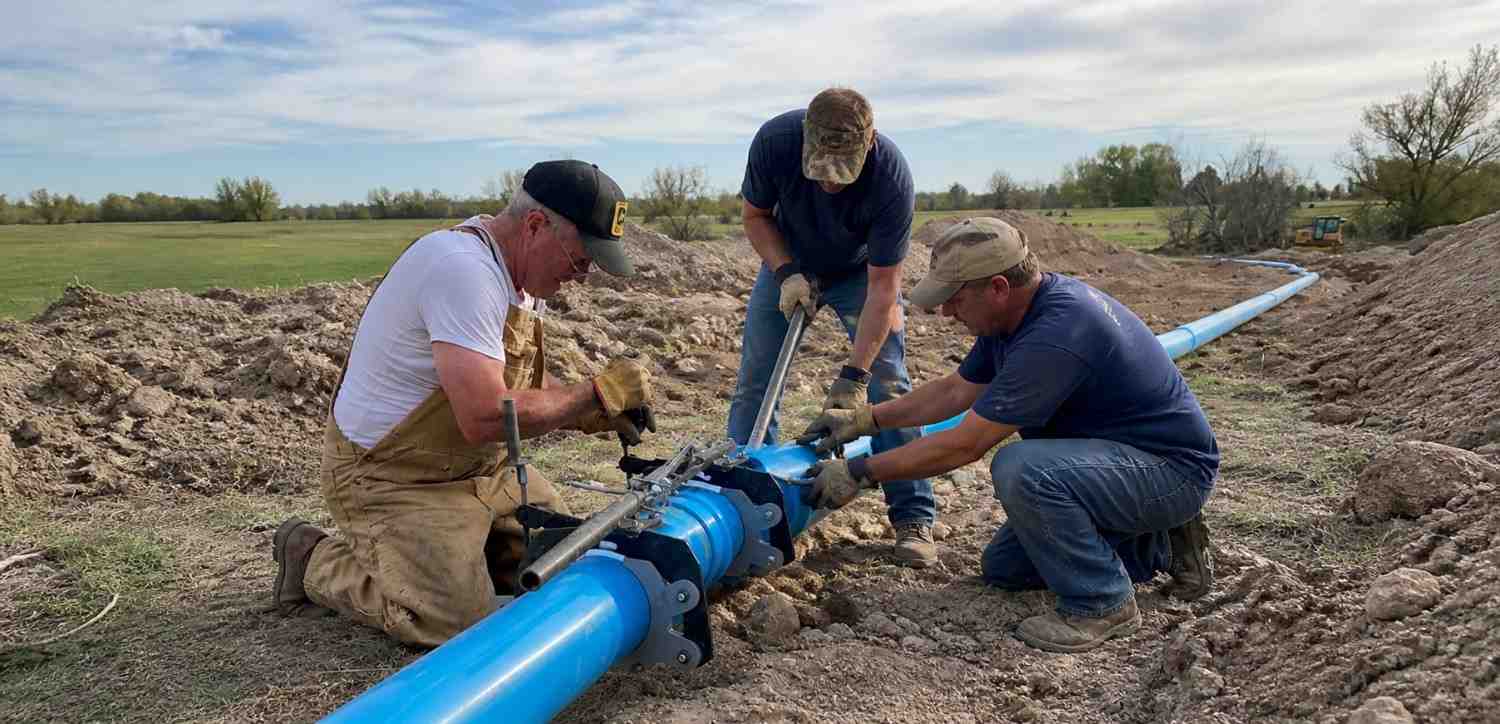
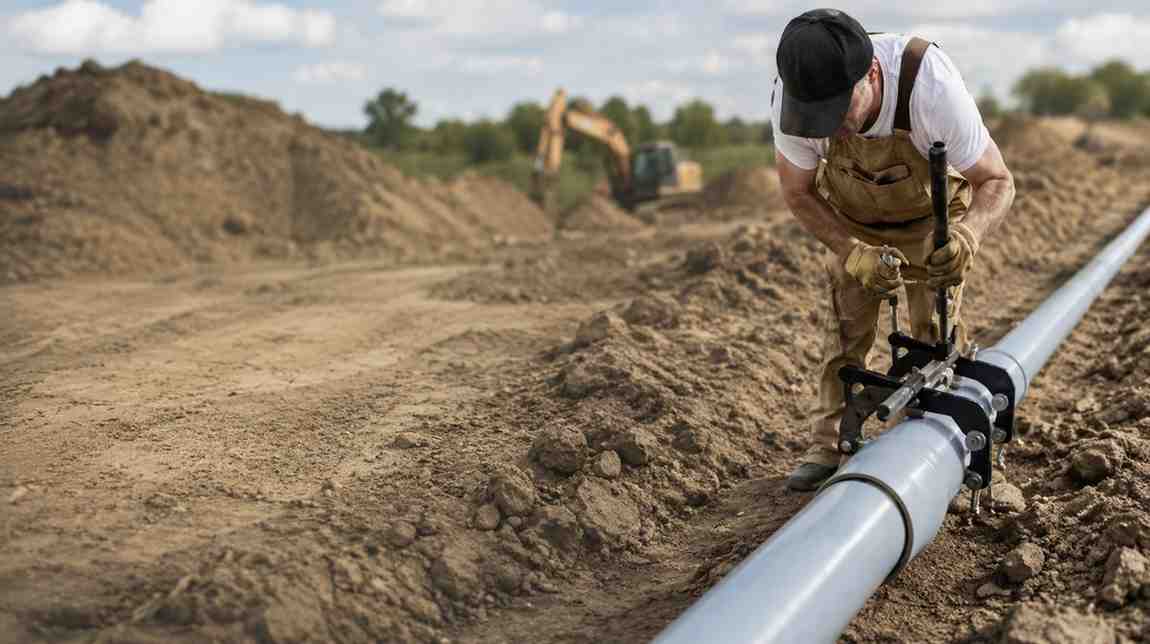
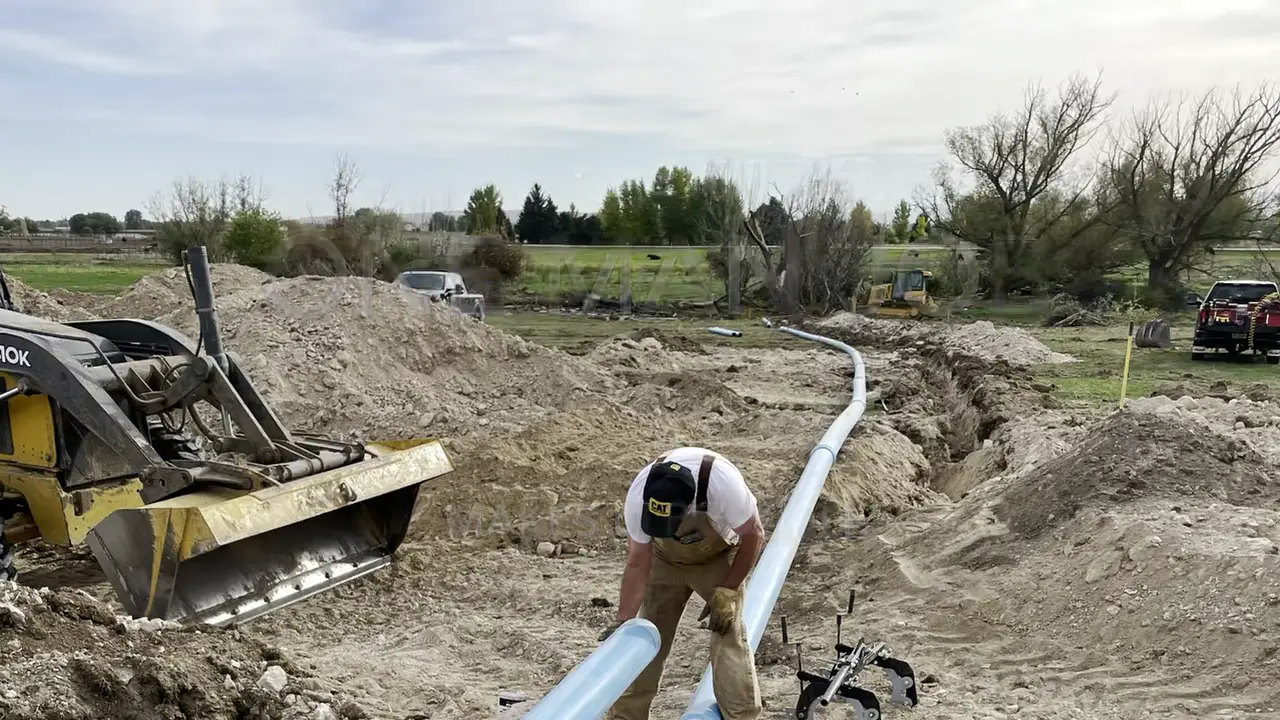
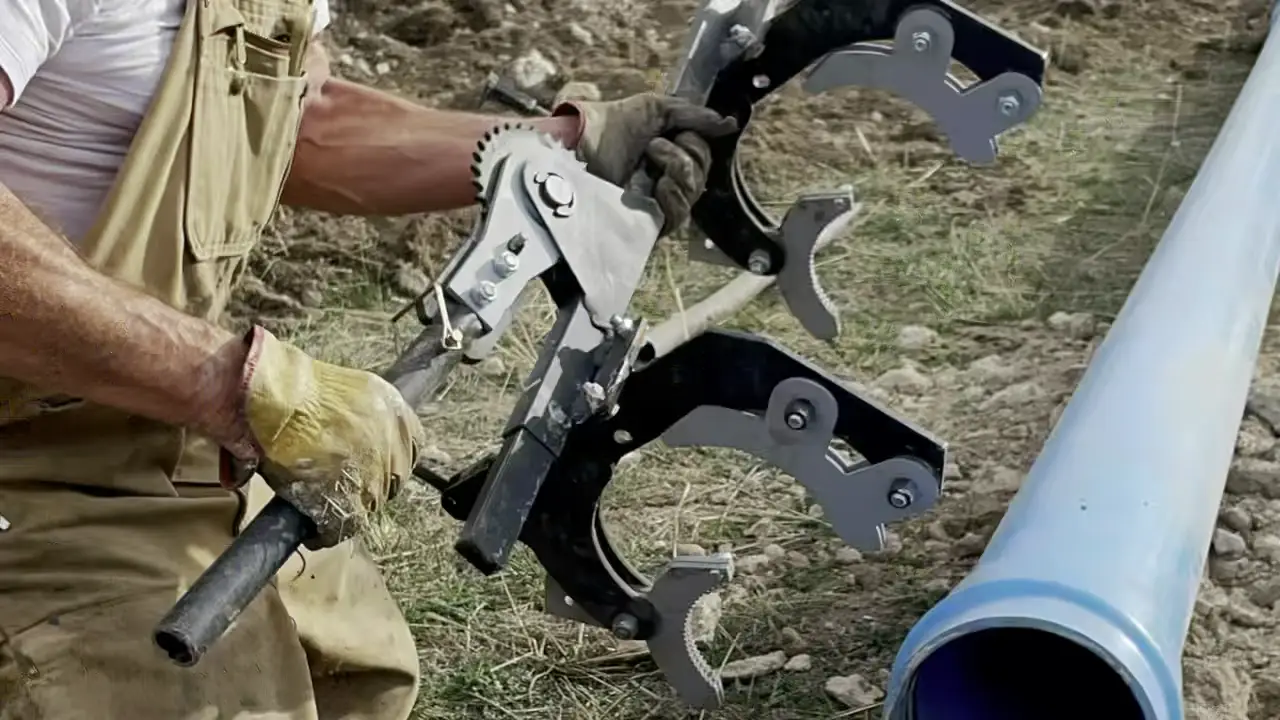
We have been building a solution to that problem since 2004. Our PVC pipe joining tool is a single-operator mechanical clamp built for contractors, irrigation crews, and industrial pipeline teams working with PVC pipe at 3 inches and above.
How it works on each joint:
- Lock the stationary clamp around the bell end, and the traveling clamp around the spigot
- Clean, prime, and apply PVC cement to both surfaces
- Engage the ratchet or lever for a smooth, controlled pressing force
- Confirm full insertion depth and release
We deliver up to one ton of controlled pressing force through an all-steel drive mechanism, with no plastic components. One operator handles the full process on pipe from 3 to 12 inches, covering Schedule 40, Schedule 80, SDR, DWV, and CIOD C900 gasket pipe.
| Failure Point | Manual Joining | Our Tool |
| Under-insertion | Common, effort-dependent | Eliminated: full depth confirmed every joint |
| Angular entry | No control mechanism | Stationary and traveling clamps align axially |
| Crew requirement | 2 to 4 people for a large pipe | Single operator |
| Force consistency | Drops with fatigue | Up to 1 ton, consistent joint 1 through joint 47 |
| Over-belling | High risk with uncontrolled push | Controlled, measurable insertion |
| Push-back during cure | Difficult to hold manually | Clamp holds the joint through the initial set |
Stop Rebuilding Joints That Should Have Held the First Time
Every callback, every failed pressure test, and every reworked section comes back to installation, not materials. We give your crew the mechanical precision that manual methods cannot deliver, on every joint, across every project. Shop The Pipefitter tool or contact our team to find the right setup for your next project.
FAQ
1. Can one person really join a large-diameter PVC pipe without an extra crew?
Yes. Our tool is designed specifically for single-operator use on pipe from 3 to 12 inches in diameter. The ratchet or lever mechanism applies up to one ton of mechanical pressing force, replacing the 2 to 4 person crew typically required for manually joining large-diameter pipe.
2. What pipe schedules and systems does the tool work with?
It works with Schedule 40, Schedule 80, SDR, DWV, and CIOD C900 gasket pipe. This makes it suitable for plumbing, irrigation, HVAC, municipal water, and industrial drainage applications.
3. Does the tool work for both solvent cement joints and gasketed bell and spigot joints?
Yes. Our pipe fitting alignment tools are designed for both solvent cement joints and gasketed bell and spigot joints. For gasketed pipe, the controlled insertion helps prevent over-belling by applying precise, measurable force instead of uncontrolled manual pressure.
4. What applications is The PipeFitter built for?
Our industrial pipe alignment tools are used for plumbing and water supply systems, irrigation systems, municipal water distribution, HVAC pipelines, and industrial drainage. They are designed for PVC pipe applications with diameters of 3 inches and above.